
Cutting Costs While Spending Loudly.
When management demands cost cuts while funding executive indulgence, the strategic FBP must turn the contradiction into a visible decision, not a private complaint.

Introduction
Welcome back. Today, we are entering a familiar room for many finance professionals.
The business says cash is tight. Then the same business approves spending that behaves as if cash is bored and looking for entertainment.
The Problem

Finance is told to find a way.
Cut costs. Reduce overheads. Challenge every request. Delay non-essential spend. Push departments harder. Protect cash.
So you start doing the work.
You review subscriptions. You question travel. You challenge the supplier's increases. You ask department heads to justify budgets they already thought were lean.
Then, management books a 5-star executive retreat in Dubai.
Flights. Hotel. Strategy sessions. Dinners. Branding. The kind of spending that arrives dressed as leadership alignment, but walks like indulgence.
Now, finance is in a difficult position.
If you challenge it, you are negative. If you stay silent, you become complicit. If you cut junior staff training while executive comfort remains untouched, the business sends a message louder than any town hall.
The message is simple - Sacrifice is for other people.
This is where many finance professionals get stuck. They feel the hypocrisy, but they do not know how to handle it without sounding emotional, political, or disrespectful.
The strategic FBP does not rant about hypocrisy. The strategic FBP translates hypocrisy into financial consequence.
A Story
I once worked with a finance lead called Adaora in a company that had just launched a cost reduction exercise.
The instruction was firm. Every department had to cut discretionary spend by 15%. Training was paused. Recruitment was frozen. Marketing campaigns were reduced.
Adaora did the work. She built the tracker. She challenged the assumptions. She helped department heads separate essential spend from comfort spend.
Then the executive team approved an overseas retreat. The first version of the budget landed in finance at just over 80% of the savings target expected from the entire operations team.
That number changed the conversation.
Adaeora did not call anyone wasteful. She did not send a long email about optics. She prepared one page.
On the left side, she showed the proposed retreat cost. On the right side, she showed what the business had already asked other teams to give up to save the same amount. Training cancelled. Customer visits reduced. Software renewals delayed. Two temporary roles left unfilled.
Then she asked one question in the meeting.
“Are we saying this retreat creates more value than the items we are asking the business to sacrifice?”
That question did not kill the retreat. That was not the point. It forced leadership to own the trade-off. The retreat was reduced. Some training was restored. More importantly, finance stopped being the department chasing small savings while big decisions escaped scrutiny.
Ajibola’s Tips

1. I turn the cost-cutting mandate into a visible project. I have learned that finance gets exposed when cost-cutting mandates are treated unseriously due to perceived management behaviour. If management says, “Find a way to cut costs,” do not let that remain a vague request sitting inside your head. Convert it into a tracker with owners, targets, deadlines, savings identified, savings approved, savings realised, and decisions pending. You may not be able to stop leadership from approving high costs. But you can make it clear that finance is doing the disciplined work of protecting cash, and that every saving has a status.
Action Tip: Create a cost-saving tracker with six columns: opportunity, owner, target saving, current status, decision required, and realised saving. Share the first version with management before the next cost review.
2. I quantify the trade-off. Moral arguments are easy to dismiss, but trade-offs are harder to escape. If you say, “This looks bad,” the room can debate tone. If you say, “This retreat equals 68% of the savings we are asking from the commercial team,” the room has to deal with the number. The strategic FBP converts discomfort into comparison.
Action Tip: Pick one questionable spend and express it as a percentage of the current savings target or as the equivalent of specific items being cut.
3. I separate cost control from cost theatre. I have seen businesses punish visible small spend while protecting invisible big waste. Removing office refreshments while ignoring executive excess is not discipline. It is theatre. It creates resentment and rarely changes the economics of the business. Your role is to help leadership distinguish symbolic savings from material savings.
Action Tip: Review the current cost-cutting list and mark each item as material, symbolic, or politically convenient. Bring the material items to the next discussion first.
4. I ask leadership to rank value. When a senior team wants to spend during a cost-cutting period, I do not start with an accusation. I ask what value the spend is expected to create and what lower-cost option was considered. If there is no value case and no alternative, the spend is not strategic. It is a preference with a budget code.
Action Tip: For the next major discretionary spend, ask for three things before approval: expected value, a lower-cost alternative, and the consequence of not spending.
5. I document the decisions. I’ve learned that finance must not become the silent witness to selective discipline. If leadership chooses to proceed, that is their authority. But the financial implications, the trade-off, and the risk should be recorded. Documentation changes the room. It turns informal preference into accountable choice.
Action Tip: Add a decision note to your next cost discussion. Capture what was approved, what was rejected, the trade-off accepted, and who owned the decision.
“Cost discipline is not real until leadership is willing to apply it to its own comfort. FBPs help hold up that mirror” - Ajibola Jinadu
Grow With Us
If today’s issue resonated with you, the next step is learning how to challenge leadership decisions with commercial clarity, not personal frustration.
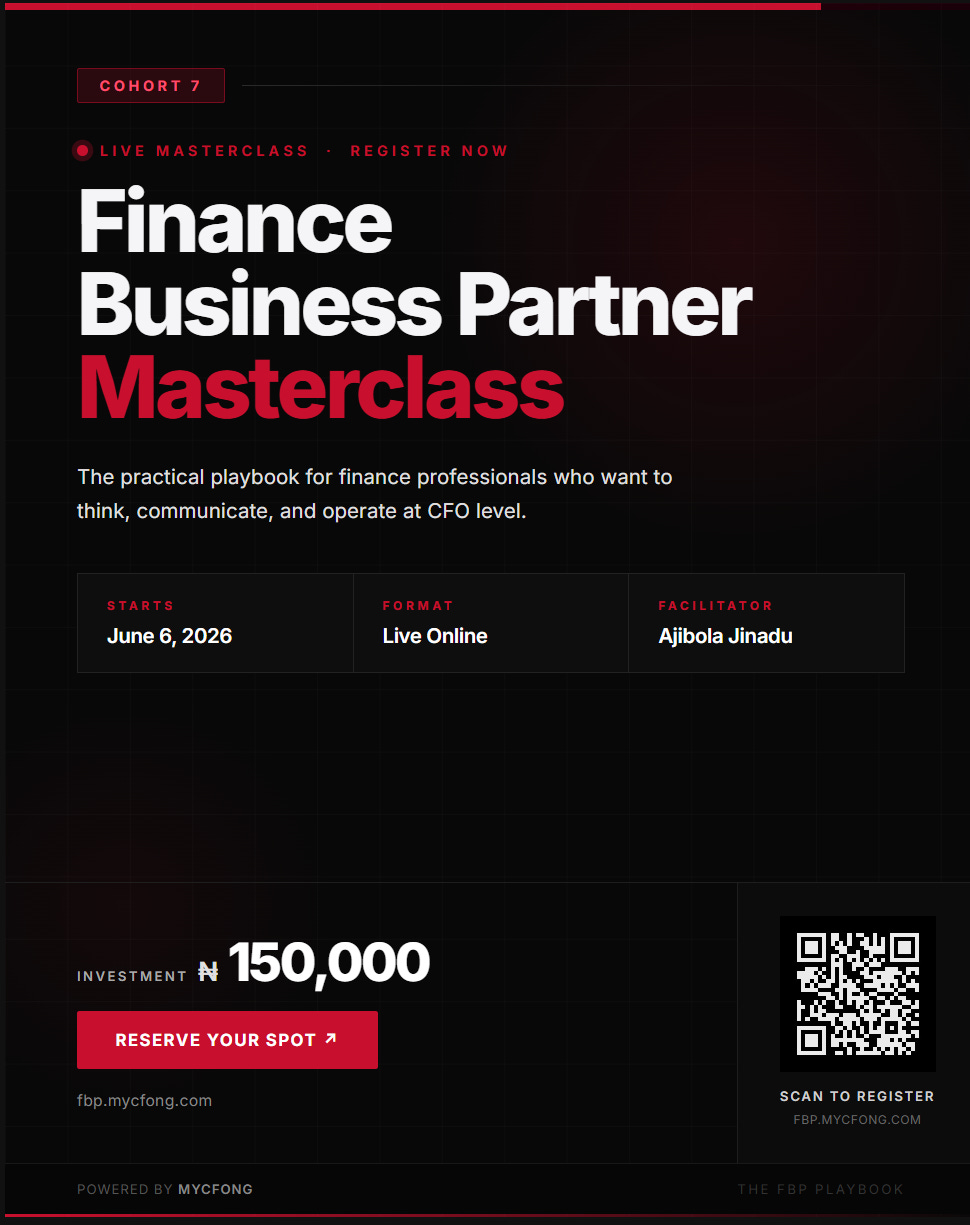
The Finance Business Partner Masterclass. If you want to become the kind of FBP who can turn uncomfortable spending contradictions into strategic conversations, the Masterclass will help you build the language, tools, and confidence to do it well. Join the Masterclass here
Conclusion
You are not there to shame leaders for wanting comfort, travel, visibility, or convenience. But you are there to protect the integrity of the financial message.
If the business says costs must come down, leadership spending must enter the same conversation as everyone else’s spending. Not because leaders cannot spend. Because every spend during a cost-cutting season is a signal.
Your work is to make the signal visible.
Start this week. Take one contradictory spend. Quantify it. Compare it. Ask the trade-off question. Then document the decision like a strategic FBP, not a frustrated observer.