
Available Everywhere. Effective Nowhere.
Finance Business Partners rarely struggle because they try to fix too much, too quickly, and all at once.

So let me share something that matters. In this new series, I want to walk you through how to earn real influence as a Finance Business Partner when the business is messy, unstructured, and moving faster than the control environment can comfortably handle.
And the first lesson, in my experience, is surprisingly simple.
Do not try to be useful everywhere.
The Problem

When you first step into a true partnering role, the problems usually announce themselves very quickly.
Margin is leaking. Cash is tight. Pricing feels inconsistent. Stock is misbehaving. Reports are late. Forecasts are weak. Sales wants support. Operations wants answers. And the CEO wants finance to “be more strategic.”
The natural reaction is to respond to all of it. So you attend every meeting. You build every report. You chase every variance. You comment on every issue. You become visible in many places, but not yet valuable in a way the business can clearly feel.
That is the quiet trap. A lot of new FBPs assume influence comes from being available. It does not. In my experience, influence comes from impact. And impact always requires focus. The business will not trust you simply because you have opinions on 10 things. It begins to trust you when you help move one thing that genuinely matters.
Partnering is not about being everywhere. It is about being effective somewhere that counts.
A Story
A while ago, I worked with a finance professional who had just moved from a reporting role into a strategic one
Let me call her Kemi. She was sharp, technically strong, fast with numbers, and trusted within the finance team. But three months into the role, she was already exhausted.
She was supporting sales, operations, procurement, inventory, and the CEO’s monthly pack. She had created new trackers, joined more meetings, and started more improvement conversations than anyone expected.
On paper, she was busy. In practice, nothing had changed.
The Sales Director was still giving discounts without properly checking margin. Operations was still complaining about stock-outs. The CEO was still asking why cash was tight when revenue looked healthy. Every week brought a new fire, and Kemi kept running towards it.
In one of our conversations, I asked her a very simple question.
“What is the one thing the business will say you improved?”
She paused. She paused because her effort had spread so widely that no clear result bore her name.
That was the turning point. So we stopped trying to fix everything. Instead, she chose one lever: discount discipline. She reviewed the last 30 sales deals, identified where margin was being given away, and helped implement a simple approval rule.
Within weeks, the conversation changed very quickly.
“Kemi helped us stop selling badly.”
That is the difference.
Ajibola’s Tips

1. I learned to look for the first visible win before I chase the complete solution.
Early in my finance career, I watched good professionals bury themselves in ambitious transformation plans that looked impressive on paper but changed very little in the business. That taught me to respect visible proof. Before the business believes your broader thinking, it usually needs to feel one clear result first.
So before you try to redesign the whole business, identify one lever where a small but meaningful improvement will be noticed quickly.
Action Tip: This week, write down 5 real financial problems in your business. Circle the one where a visible improvement can happen within thirty days.
2. I learned to separate noise from pain, because not every request deserves your action.
I have sat in enough meetings to know that every department can make its issue sound urgent. Some issues reflect real business pain. Others are simply preference, politics, or weak planning wearing the clothes of urgency.
As an FBP, you need to know the difference. Pain affects money, decisions, customers, cash, margin, or risk. Noise usually affects comfort.
Action Tip: Take your current work list and mark each item as either Pain or Noise. Keep only the Pain items on your strategic focus list.
3. I ask, “Who truly feels this problem?” before I commit serious energy.
I learned this after spending time on issues that finance cared about, but the rest of the business was not yet ready to act on. If the CEO, Sales Director, Operations Head, or Commercial Lead does not feel the pressure of the issue, your insight may be correct and still go nowhere.
Do not choose your first win in a place where nobody is uncomfortable. Choose where the business already feels the cost.
Action Tip: Pick one issue you want to work on and name the influential person who currently feels the pain most. If you cannot name that person, choose another issue. At best, talk to them.
4. I avoid first wins that make finance look like the police.
There is a time to challenge waste, weak controls, and poor behaviour. That matters. But if your first visible move is only restriction, the business may label you before it understands your value. And that affects every other initiative you want to pursue.
Your first win should help the business perform better, not just behave better. Once people trust your intent, the harder conversations become easier.
Action Tip: Review your chosen issue and write one sentence explaining how solving it helps the business grow, protect cash, or improve profit.
5. I make the first win simple enough to repeat in one sentence.
If it takes 10 slides to explain why your work mattered, the business may not remember it. People remember clear results: protected margin, improved cash, stopped discount leakage, reduced stock waste.
Your reputation inside the business begins with what people can repeat about your contribution when you are not in the room.
Action Tip: Write your first-win sentence in this format: “I helped the business improve [specific lever] by changing [specific decision or behaviour].”
“You do not earn influence by touching everything lightly. You earn it by moving one thing people can genuinely feel.” - Ajibola Jinadu
Grow With Us
If this issue resonated with you, then the next step is to become the kind of finance professional who creates visible business impact, not just better reports.
The Finance Business Partner Masterclass. This is where I teach finance professionals how to move from reporting the numbers to shaping the decisions behind them. [Join the Masterclass here]. (Only 4 days to go before we start.)

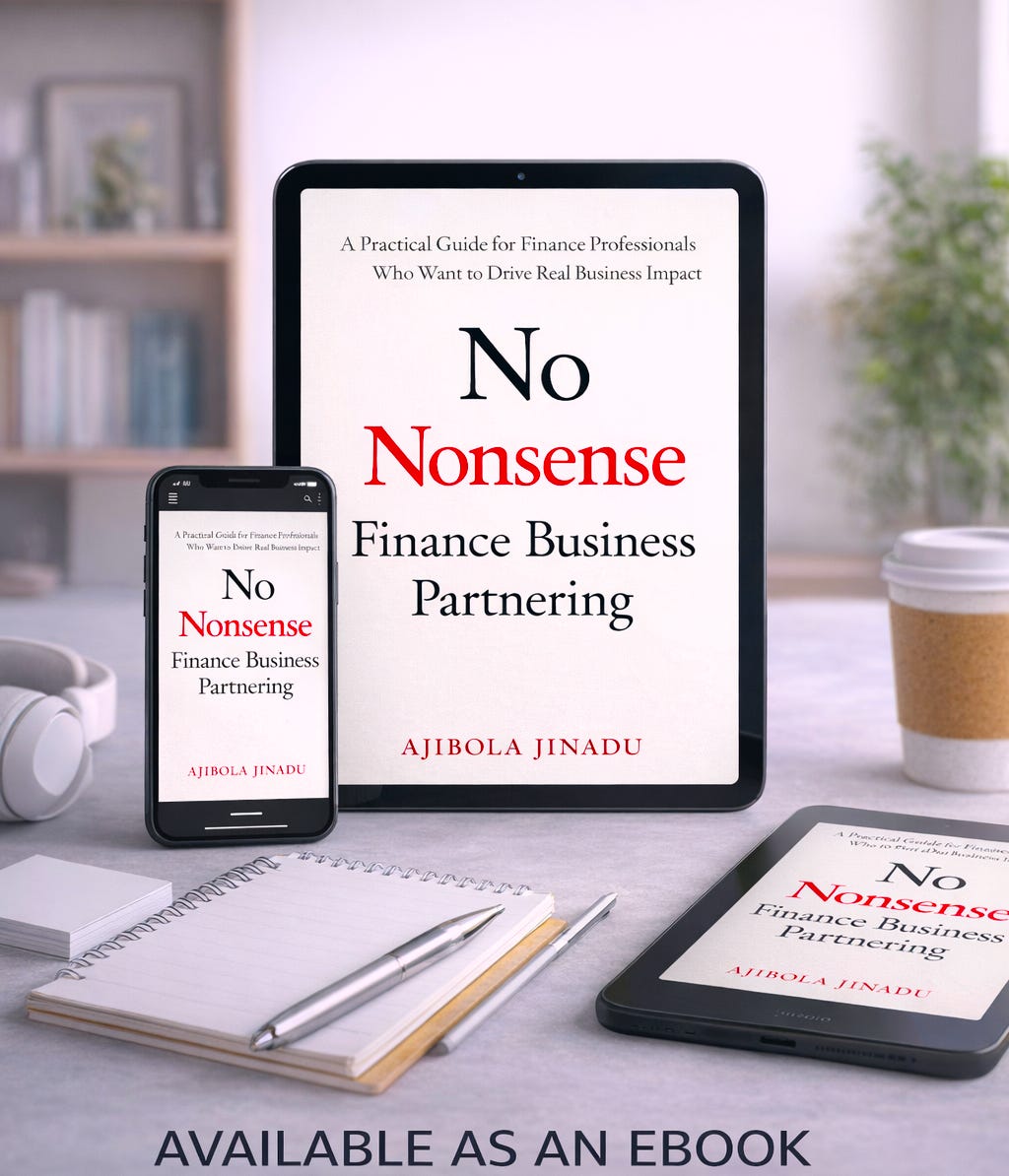
The No Nonsense Finance Business Partnering eBook. If you want a practical guide you can read and apply at your own pace, start with the eBook. [Get your copy here]
Conclusion
A new FBP does not need to prove that they can solve every problem in the business. They need to prove they can move one important thing.
That is what changes how the business sees you. Not your title. Not how many meetings you attend. Not how many reports you produce. One clear win that leaders can feel, remember, and repeat.
Start small, but not trivially. Choose the issue with real pain, frequent decisions, and enough room for finance to shape the outcome. Then stay with it long enough for the business to notice the change.
Tomorrow: We will look at margin leaks as one of the first levers you should focus on, and why revenue growth can hide a business that is destroying value.
Subscribe so you do not miss it.
Cheers,
Ajibola